
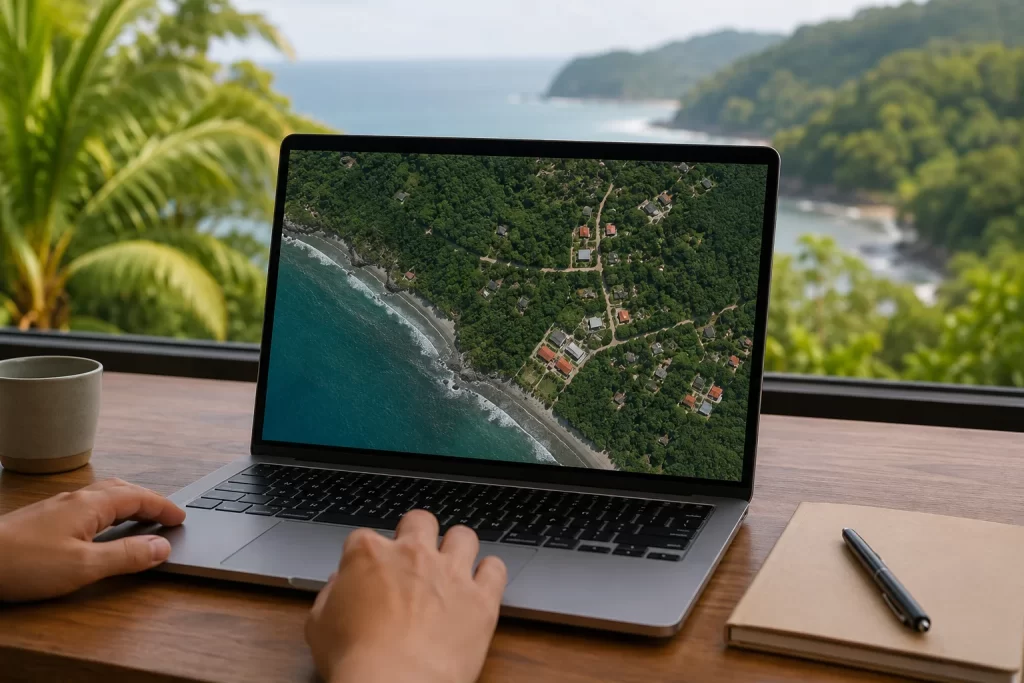
If you are planning to buy land, a house, or an investment property in Costa Rica, one of the first questions you may ask is: Can I verify a Costa Rica property location using Google Maps? The short answer is yes, partially. Google Maps is a useful starting point, but it should not be your only verification tool.
Many foreign buyers search for terms such as verify property location Costa Rica, Costa Rica property Google Maps, and how to find property location Costa Rica because property descriptions often include landmarks, rural addresses, or GPS coordinates instead of traditional street numbers.
This guide explains how to use Google Maps effectively, what its limitations are, and which official tools you should use before completing a real estate transaction.
Why Verifying a Property Location Matters in Costa Rica
Costa Rica uses a property identification system based on cadastral plans (plano catastrado) and registry information rather than relying solely on street addresses.
Verifying the location helps you:
- Confirm that the property shown by the seller actually exists.
- Check access roads and nearby infrastructure.
- Identify proximity to beaches, rivers, protected areas, or flood zones.
- Compare the advertised location with the registered cadastral coordinates.
- Avoid boundary disputes and misleading listings.
For buyers working with Trade and Law, verifying the exact location is an essential part of the due diligence process before purchasing Costa Rican real estate.
How to Find a Property Location on Google Maps
Search by Coordinates
The most reliable way to find property on Google Maps Costa Rica is by using latitude and longitude coordinates.
Example:
10.3000, -85.8400
To search:
- Open Google Maps.
- Paste the coordinates into the search bar.
- Press Enter.
- Review the satellite view and surrounding area.
Many Costa Rican real estate listings provide GPS coordinates because rural properties may not have a precise postal address.
Use Satellite View
After locating the coordinates:
- Switch to Satellite mode.
- Zoom in to identify buildings, roads, rivers, and topography.
- Compare the visible features with the listing photos.
This method is especially useful for properties in Guanacaste, the Central Pacific, and other rural regions where street names may be inconsistent.
Can Google Maps Confirm Legal Property Boundaries?
No. This is the most important limitation.
Google Maps can help you identify the approximate location, but it cannot legally verify property boundaries, ownership, or cadastral limits.
To confirm legal boundaries, you need:
- The cadastral plan number.
- A copy of the property survey (plano).
- Registry information from the Registro Nacional de Costa Rica.
The National Registry provides official cadastral and ownership information through its online services.
Official Tools for Costa Rica Property Verification
National Registry (Registro Nacional)
The official registry allows you to verify:
- Property ownership
- Folio real number
- Cadastral plan references
- Recorded liens or mortgages
Official source: https://www.rnpdigital.com/
National Geographic Institute (IGN)
Costa Rica’s geographic authority provides cadastral and mapping resources that can help compare survey information with real-world geography.
Official source: https://www.ign.go.cr/
Step-by-Step Verification Process
1. Obtain the Seller’s Information
Request:
- Folio real number
- Plano catastrado number
- GPS coordinates
- Recent survey if available
2. Locate the Coordinates in Google Maps
Use the coordinates to identify the approximate parcel and surrounding features.
3. Compare With the Cadastral Plan
Check whether the shape, orientation, road access, and neighboring properties match the survey.
4. Confirm Ownership Through the Registry
Verify that the registered owner matches the seller and that there are no unexpected encumbrances.
5. Conduct Professional Due Diligence
A qualified Costa Rican real estate attorney can coordinate:
- Registry searches
- Municipal zoning review
- Boundary verification
- Environmental restrictions
- Closing documentation
If you are considering purchasing property, the Trade and Law real estate team offers legal assistance for buyers who need help reviewing registry documents, cadastral information, and transaction risks. Learn more about their real estate services at https://tls.cr/en/bienes-raices/.
Common Problems Google Maps Can Reveal
Although it is not a legal verification tool, Google Maps can help detect potential issues:
Incorrect Advertised Location
Sometimes a listing claims to be “5 minutes from the beach” when the satellite view shows a much greater distance.
Lack of Road Access
Satellite imagery may reveal that the property has no visible public road connection, which can create serious legal and practical problems.
Nearby Rivers or Steep Terrain
Topographic features visible on the map may indicate flood risks, erosion concerns, or difficult construction conditions.
When You Should Contact a Professional
You should seek legal guidance if:
- The seller cannot provide a cadastral plan.
- The coordinates do not match the advertised property.
- Multiple parcels appear to overlap.
- Access roads cross neighboring land.
- The property is located in a maritime zone, protected area, or rural agricultural zone.
For personalized assistance with Costa Rican property verification, buyers can contact Trade and Law directly through their contact page: https://tls.cr/en/contacto/.
Frequently Asked Questions
Can I verify a Costa Rica property location using only Google Maps?
You can verify the approximate physical location, but you cannot confirm legal ownership or property boundaries using only Google Maps.
How do I find property coordinates in Costa Rica?
Ask the seller for the GPS coordinates or obtain them from the cadastral survey (plano catastrado).
Is Google Maps accurate enough for real estate purchases?
It is accurate enough for orientation and preliminary research, but not for legal due diligence.
What is the official way to verify a Costa Rica property?
The official verification requires checking the Registro Nacional, reviewing the cadastral plan, and confirming the information with a qualified real estate attorney.
Can Trade and Law help verify property location and ownership?
Yes. Trade and Law provides legal support for Costa Rica real estate transactions, including registry review, cadastral verification, and buyer due diligence.


 Spanish
  English